Performance marketing Introduction: The Shift from Traditional Advertising to Measurable Growth
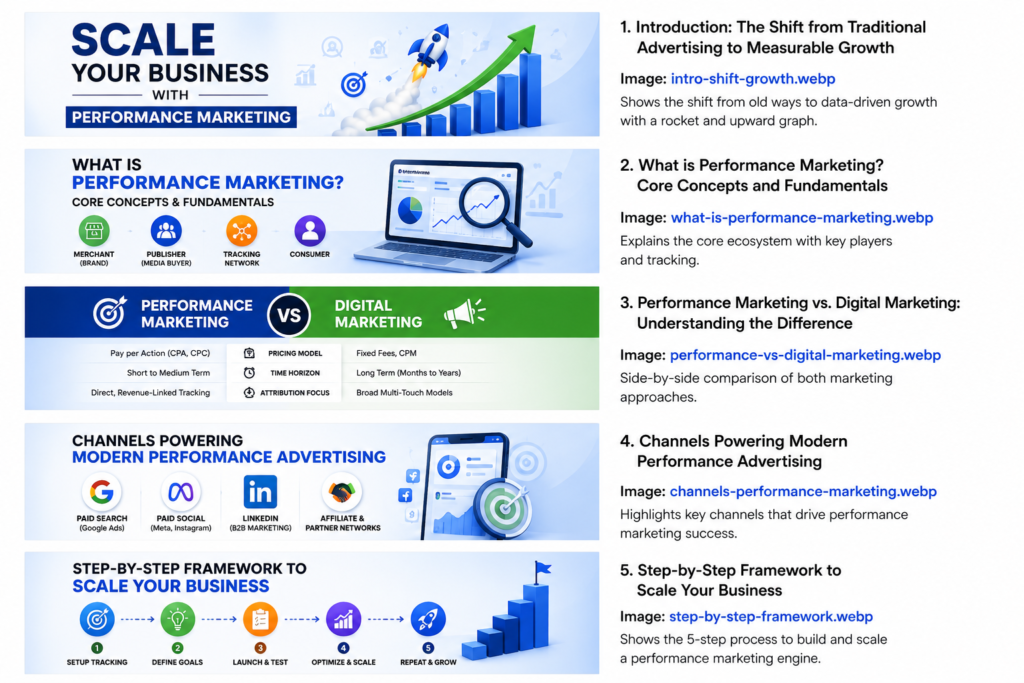
Traditional advertising often felt like a guessing game. Businesses spent massive budgets on billboards, TV commercials, and print ads without any clear way to measure if those investments actually brought in customers. You paid for visibility, not results.
Performance marketing completely changes this approach by focusing entirely on measurable growth. Instead of paying upfront for empty promises, you only pay when a user takes a specific, valuable action—like clicking a link, filling out a form, or buying a product. This data-driven shift turns your marketing from an unpredictable expense into a safe, reliable engine for steady business growth.
What is Performance Marketing? Core Concepts and Fundamentals
In today’s digital business environment, performance marketing is one of the types of advertisements that really changes everything because it is focused on results and accountability. While in traditional types of advertising companies pay in advance for placing their ads without knowing the results that they will achieve, here every penny is tied to measurable results. The purpose of a campaign could be getting a lead, having a user install an app, or fulfilling an e-commerce order and businesses only pay for any campaign when the goal is consummated. This accountability leads to fundamental changes in the process of managing the advertising budget by various businesses.
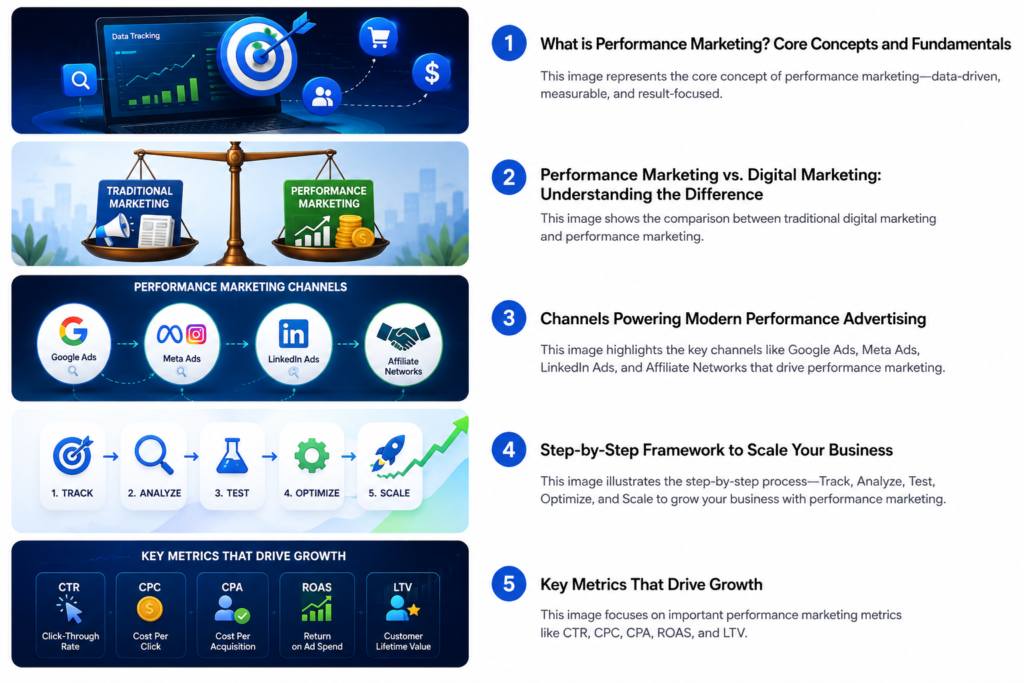
The process of functioning of performance marketing can be based on four major elements of the system:
Merchant or Brand: the company that sells the product or service that is going to the market.
Publisher or Media Buyer: the organization, affiliate, or platform that is responsible for attracting traffic to the project.
Tracking Network: the smart solutions to monitor all the actions of users.
Consumer: the person who sees the advertisement and performs the action.
The application of performance marketing provides companies with a chance to thoroughly manage their profits because if
How the Ecosystem Works
The performance marketing system runs on four parts:
- The Merchant / Brand: The company selling a product or service.
- The Publisher / Affiliate / Media Buyer: The platform bringing traffic.
- The Tracking Platform / Network: Tools like GA4, pixels, or server-to-server setups that record actions.
- The Consumer: The user who completes the goal.
Using performance ads, brands protect their margins. If a campaign doesn’t earn back its cost, you can pause it before wasting money. This control keeps finances healthy and growth steady.
Performance Marketing vs. Digital Marketing: Understanding the Difference
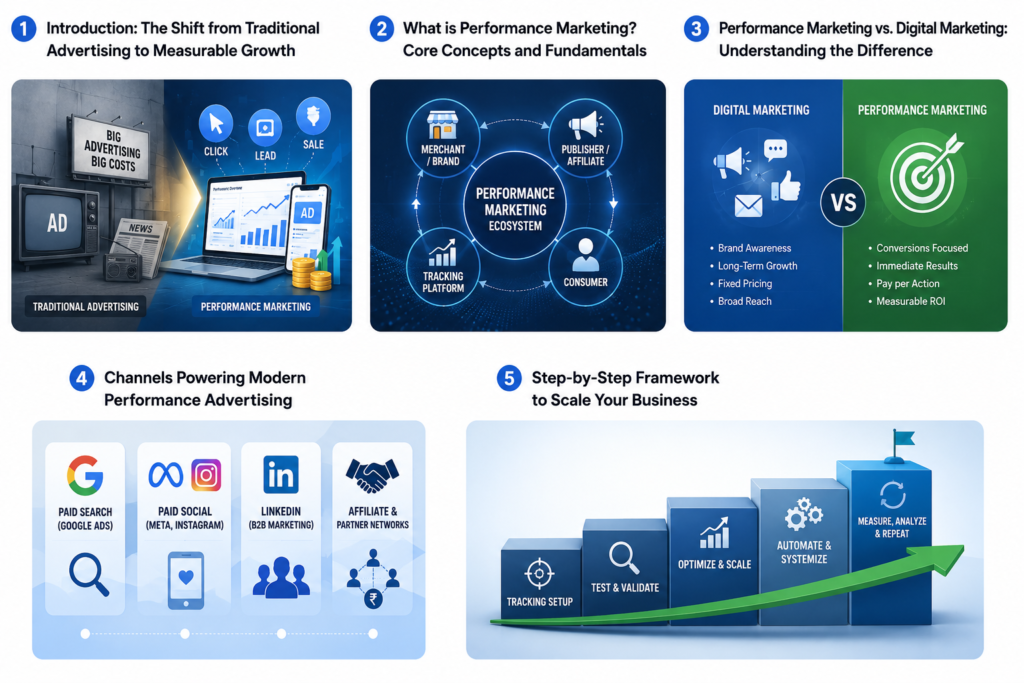
Many people mix up digital marketing with performance marketing. While they are related, they are distinctly different:
| Feature | General Digital Marketing | Performance Marketing |
| Primary Objective | Build brand awareness and long-term trust | Get immediate conversions, leads, and sales |
| Pricing Model | Fixed fees, CPM, monthly retainers | Pay per action (CPA, CPC) |
| Time Horizon | Long-term (months to years) | Short to medium term with quick changes |
| Attribution Focus | Broad multi-touch models | Direct, revenue-linked tracking |
Traditional digital marketing builds the foundation, while performance marketing pulls in cash. Both matter, and success today requires a balanced approach combining the two.
Channels Powering Modern Performance Advertising
To scale effectively, you must pick the right channels. Each plays a specific role at different stages of the customer journey.
1. Paid Search Engine Marketing (Google Ads & Bing)
Search ads reach people actively looking for solutions. When someone types a keyword, your ad appears. These users are ready to buy, making search ads work best near the end of the funnel.
2. Paid Social Media Channels (Meta, Instagram, LinkedIn)
Social media platforms use advanced targeting. Meta and Instagram let you reach people based on interests, behavior, and lookalike audiences. For B2B, LinkedIn gives direct access to decision-makers and executives.
3. Affiliate and Partner Networks
These networks connect you with third-party publishers who promote your products only when they make a sale. You pay nothing unless there’s a conversion, which lowers risk and cuts upfront costs.
Step-by-Step Framework to Scale Your Business
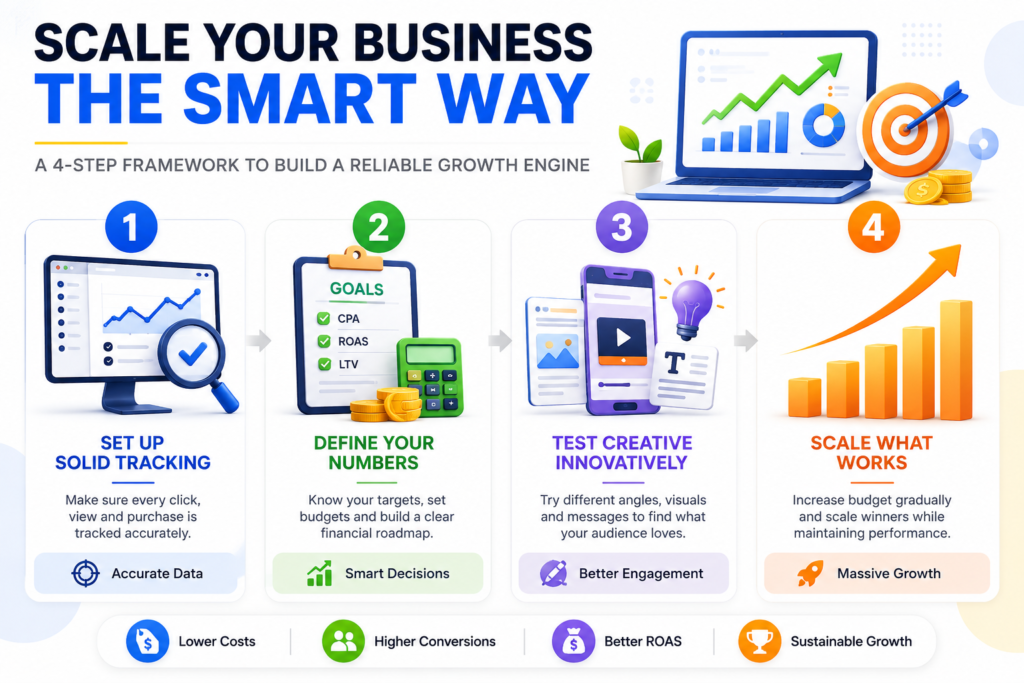
Scaling with performance marketing needs a structured plan. Follow these steps to build a reliable growth engine:
- Step 1: Establish Bulletproof Tracking Architecture:-Don’t launch any ads until your tracking is perfect. Wrong data trains algorithms poorly, leading to wasted money. Use server-side tracking, Meta Conversions API, and GA4 event setups to capture every click, view, and purchase accurately.
- Step 2: Define Clear Financial Guardrails and KPIs:-Before starting, set your numbers. Know your cost per acquisition (CPA) target, return on ad spend (ROAS), and customer lifetime value (LTV). If you need help building these models, you can consider Free Audit / Consultation to audit and structure your analytics framework.
- Step 3: Build a Dynamic Creative Testing Engine:-Ads lose impact over time as people get tired of seeing the same message. To stay effective, create new versions often. Test headlines, videos (like user-generated content), and copy regularly to find what works best.
- Step 4: Scale Winners Incrementally:-Once you find a winning setup with a strong CPA and high conversion rate, grow it slowly. Increase your budget by 15% to 20% every few days to avoid resetting the algorithm’s learning phase and keep performance steady.
Overcoming Common Scaling Bottlenecks and Pitfalls
Even with good tools, many brands hit roadblocks when growing fast. Here are common mistakes and how to avoid them:
1. Ignoring Attribution Complexity
One-click attribution lies. A buyer might see your Instagram ad, search on Google, then buy via email. If you only credit the click, you’ll kill early-stage channels too soon. Use multi-touch models to give proper credit across all touchpoints.
2. Scaling Broken Conversion Funnels
Pumping money into a broken website is pointless—it’s like pouring water into a leaking bucket. Before expanding media spend, fix your conversion process. Optimize landing pages for speed, mobile design, and clarity, making your value proposition unmistakable.
3. Neglecting Customer Lifetime Value (LTV)
Focusing solely on first-time buyers hurts long-term health. To grow sustainably, keep customers coming back using automated emails, SMS, loyalty programs, and smart upselling. A high LTV means you can afford to spend more on acquiring new customers.
Advanced Growth Tactics and Future-Proofing Your Campaigns
As competition grows, basic tactics aren’t enough. You need advanced strategies to stay ahead of the curve.
1. Programmatic Media Expansion
Go beyond Google and Meta. Use platforms to run ads across thousands of websites and apps. These systems use AI to target precisely while keeping your budget limits strictly in check.
2. Behavioral Segmentation and Hyper-Personalization
Treating everyone as one group won’t work well. Modern scaling needs micro-segments. Look closely at user behavior—such as time spent on product pages, cart abandonments, and past purchases—then serve ads tailored specifically to those patterns to boost engagement.
3. Cultivating Strategic Agency Partnerships
Handling everything alone is hard. Technical tracking, touch attribution, and rapid creative updates require expert skill. Partnering with a performance marketing agency brings deep expertise, tools, and speed to help you grow faster and reduce risks.
Deep-Dive Analysis: The Psychological and Technological Drivers of Modern Ads
To win at advertising, you must understand the mind behind the machine. Today’s ads don’t rely just on age or location; they analyze fine details like how long someone watches a video, whether they mute the sound, and whether they scroll back up.
Creative assets become the primary tool for targeting. Algorithms learn from these behavioral signals, making a continuous pipeline of fresh creatives essential. Use testimonials, authentic stories, and local cultural elements to build trust in digital spaces.
Additionally, linking CRM data with ad bidding makes sure you spend based on actual sales, not vanity clicks. This technical alignment turns marketing into a self-improving engine where every campaign learns, improves, and scales predictably.
Comprehensive Frequently Asked Questions (FAQs)
- What is performance marketing?
Performance marketing is a strategy where advertisers pay only when a specific action—like a sale or lead—is completed. - How does performance marketing differ from digital marketing?
Digital marketing includes all online branding efforts, while performance marketing is a subset focused strictly on measurable results and financial accountability. - What are the popular channels used for performance ads?
Top channels include Google Search Ads, Meta Ads, LinkedIn Ads for B2B, affiliate networks, and programmatic display. - How can a small business get started with performance advertising?
Start with one clear conversion goal, install tracking pixels correctly, set a test budget on one high-intent platform, and use incoming data to improve. - What metrics matter most when tracking campaign success?
Key metrics include ROAS, CPA, CPC, CTR, and LTV compared to acquisition cost. - Can B2B companies benefit from performance marketing?
Yes. B2B firms use LinkedIn and Google Search combined with CRM tracking to convert high-value leads into closed deals. - How do I prevent ad fatigue in my campaigns?
Rotate creatives often, test new visuals and messaging weekly, and refresh audience targets to reach unexhausted user segments. - What is a good ROAS target for e-commerce brands?
Most brands aim for a 3x to 5x ROAS after covering product creation and shipping costs. - Why are my ad campaigns suddenly experiencing higher CPAs?
Possible reasons include audience saturation, creative fatigue, higher seasonal competition, or a drop in landing page conversions. - How long does it take for ad algorithms to optimize?
Typically, 50 conversions within 7 days are needed for algorithms to exit the learning mode and stabilize performance. - What role do landing pages play in performance campaigns?
Landing pages convert clicks into sales. Load times, clean mobile design, and clear CTAs directly affect your overall campaign results. - Is it better to handle performance advertising in-house or hire an agency?
While in-house teams know the brand well, agencies bring cross-industry experience, advanced tools, and speed that often save money and boost returns. - What is attribution modeling and why is it important?
Attribution assigns credit across every step in a customer journey. Without it, you might mistakenly kill top-of-funnel channels too early. - How should I allocate budget to testing new campaigns?
Industry best practice is to route 15% to 20% of your total monthly ad spend strictly toward experimentation and testing. - How do privacy regulations affect performance marketing?
With cookie deprecation, marketers rely more heavily on first-party data, server-side tracking APIs, and contextual targeting. - How does localized targeting impact ad performance in diverse markets?
Ads using regional language, culture, and localized imagery perform far better than generic, one-size-fits-all messages. - What is offline conversion tracking and why is it vital for lead generation?
It links closed deals from a CRM back to ad platforms, teaching algorithms to optimize for actual paying buyers rather than low-quality leads. - How can dynamic creative optimization improve campaign efficiency?
AI automatically mixes headlines, images, and text variants to serve the best possible ad version to each individual user. - What signs indicate that an ad campaign should be paused immediately?
If an ad generates zero conversions despite spending budget, or if its CPA exceeds your profit margin after the learning phase, pause it immediately. - How often should performance marketing campaigns be reviewed?
Check daily for budget pacing issues and anomalies. Conduct weekly reviews to assess macro trends, creative fatigue, and ROAS shifts.
Conclusion: Take Control of Your Growth Today
Scaling a business in today’s economy means letting go of guesswork. You need precision, data, and absolute accountability. By setting up rigorous tracking, improving creatives continuously, and managing your unit economics carefully, you turn marketing from an uncertain expense into a dependable growth driver.
Ready to Scale Your Business Profitably?
If you want to stop wasting money on ads, improve your conversion funnels, and build a predictable stream of growth, you don’t have to do it alone. Partner with https://tendzo4media.in/ & https://skdigitalera.in/ a top performance marketing agency focused on delivering real, measurable results. We help ambitious brands run high-converting campaigns and achieve sustainable, long-term business growth. Contact our expert team today to request a comprehensive audit of your digital marketing setup!